
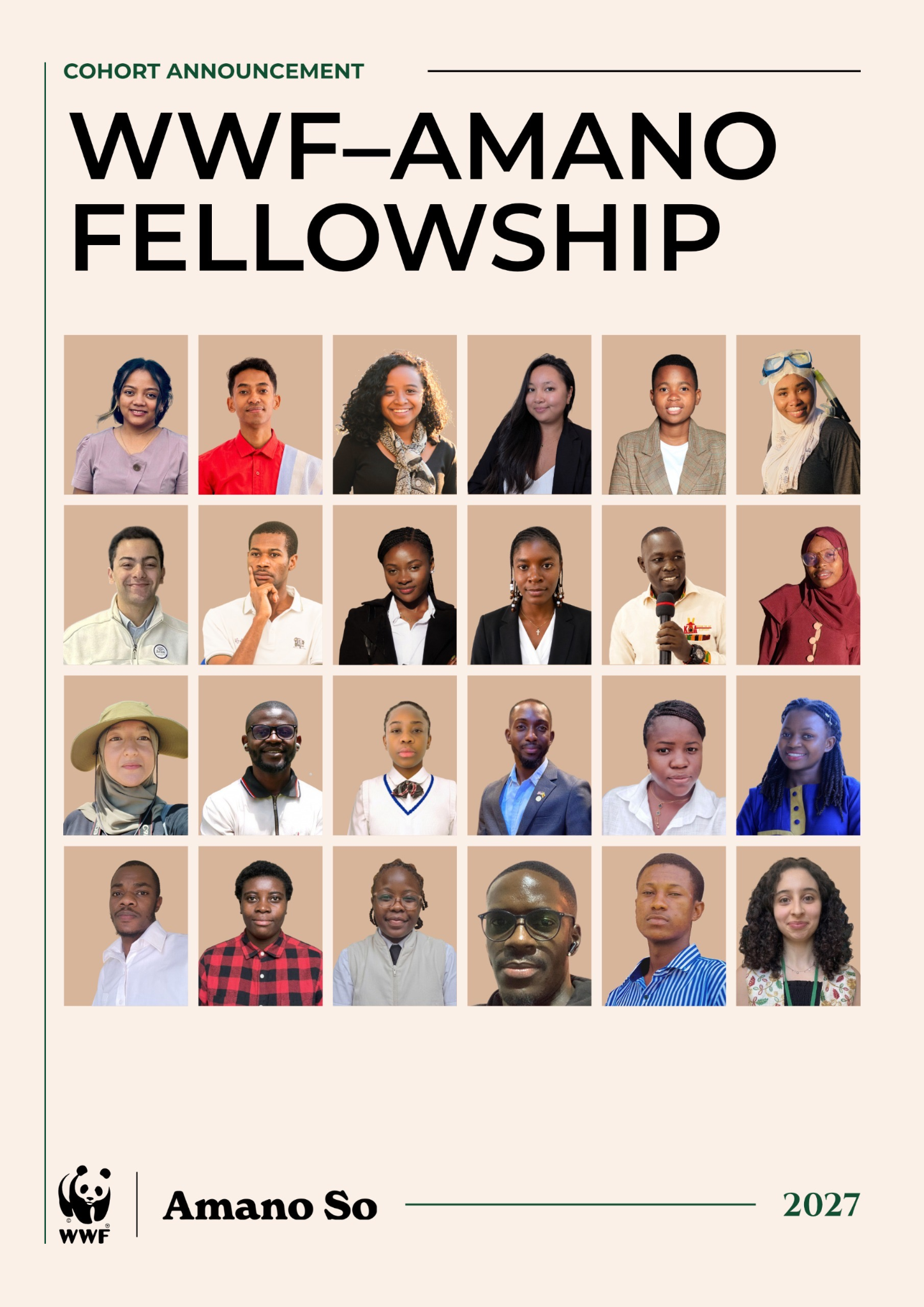
NEW YORK, November 25, 2026 – Amano So and World Wide Fund for Nature (WWF International) today announced the 24 emerging conservation leaders selected for the 2027 cohort of the WWF-Amano Fellowship. Now in its third cohort, the nine-month leadership journey brings together young activists, community leaders, founders, educators, scientists and technologists aged 21 to 30 and pairs them with seasoned mentors who help them grow, connect with peers, sustain and scale locally led solutions to the challenges facing nature and people.
The announcement comes against a backdrop of profound shifts in the world today’s young people will inherit. The triple planetary crisis of climate change, nature loss and pollution is already reaching into their daily lives. WWF’s Living Planet Report 2026 records a 73 percent average decline in monitored wildlife populations between 1970 and 2022, and the United Nations International Fund for Agricultural Development warns that “rural youth are likely to be disproportionately affected by climate change.” At the same time, artificial intelligence is rewriting the world of work around them. Yet young people are not waiting to be rescued. Across rural and local communities, they are already restoring rivers, launching enterprises and organizing their peers, often with little more than their own determination. What they rarely have is access to the networks, mentors and champions that turn local initiative into lasting influence.
The WWF-Amano Fellowship is building the infrastructure to close that gap. Between August and October 2026, ten WWF country offices across Africa put forward 56 nominees. Women make up 63 percent of the new cohort, up from 55 percent in 2026; 71 percent live in or work directly with rural and local communities; and more than half founded or lead the initiatives they represent.
“Every leader I admire can name the person who found them early and opened a door. For the majority of young people today, that moment still comes down to sheer luck and chance,” said Brighton Kaoma, Founder and CEO, Amano So. “We are not building another program. We are building infrastructure that turns that moment from luck into design – for these 24 fellows and the millions of young leaders who will follow.”
The 24 fellows work across conservation, climate action, food systems and environmental governance, and none of them waited for permission to start. Four of them show what that looks like on the ground:
Goi Joseph, Uganda, co-founded Kiryandongo Video Advocate, which trains refugees and Ugandans around Kiryandongo settlement to film their communities’ problems and screen the films for the people who can fix them. One of its films led to new water points across the settlement, putting safe water closer to families who had gone without. Since December 2023, the group has won direct funding from the Government of Uganda, the UN, the Lutheran World Federation, the Norwegian Refugee Council and STEPS South Africa.
Emelda Kachana, Zambia, youth coordinator of the Matoya Multipurpose Cooperative in Nsongwe, southern Zambia, leads young people in bringing a dried-up river back to life. By replanting riverbanks, building small dams and clearing silt from the riverbed, the cooperative is reversing deforestation driven by charcoal production, with a 5,000-tree planting drive in 2026. She draws volunteers in by pairing restoration days with traditional dance.
Plamedi Ntoto Mbodo, DRC, founded Kasavards Agroforest on the edge of the Democratic Republic of the Congo’s Luki Biosphere Reserve, where he grew up, to give farming families a living that keeps the forest standing. His 11-person team supports 150 beekeepers and smallholders across the Mayombe, tracking each farm’s progress with digital field data.
Hiba Ben Aribi, Tunisia, a biologist and farmer on the island of Djerba, is restoring her family’s land and native wildlife habitat through regenerative agriculture. She works with elderly farmers to adapt generations of practice to a changing climate.
“This Fellowship has added a powerful new dimension to WWF’s Youth Engagement Programme,” said Carol Hariklia Monoyios, Executive Director of Strategic Partnerships & Global Resource Mobilisation, WWF International. “Our Director General, Kirsten Schuijt, championed this vision when we relaunched the programme, and our partnership with Amano So has helped bring it to life. The Fellowship reflects WWF’s commitment to investing in the leadership, agency and potential of young people who are already driving positive change for people and nature.”
The Fellowship offers fellows access to leadership development opportunities and senior-level mentorship that are often difficult for young leaders to access. Each fellow sets two or three objectives for the year and pursues them with one-on-one coaching, tracked on the Amano platform. Every month, fellows meet in guided Mentor Huts – small, highly curated circles that pair senior leaders with emerging ones – and join an Expert Speaker Series. Through these sessions and practitioner-led workshops, fellows build skills including scaling local initiatives through fundraising and partnerships, influencing without authority, leading across cultures, decision-making under uncertainty, harnessing AI for personal and organizational productivity, and building personal and organizational resilience, among others. They also take part in candid conversations with C-suite executives and top leaders across government, the corporate sector and multilateral institutions.
Fellows carry that training far beyond the nine months. On the global stage, previous fellows have spoken at the United Nations Climate Conferences (COP), Climate Week NYC and WWF International convenings. At home, they have launched initiatives and start-ups and raised capital to grow them. In Uganda’s Rwenzori Mountains, 2026 fellow Mathew Mbusa secured funding to build a coffee value-addition centre that lets local growers capture more of the value of their harvest. Fellows also describe another transformation: sharper clarity of purpose, deeper empathy for self and others, and the confidence to lead. And they now collaborate across borders, in a network that has grown to 11 countries across Africa and Asia since the first cohort. Afterwards, they join a lifelong alumni community that convenes across cohorts, countries and disciplines, and many return to shape what follows: alumni of the 2025 cohort sat on the selection panels for 2027, and a first group of alumni will be trained as Mentor Hut Guides to co-lead future circles.
“The future of our planet is shaped by ordinary people who choose to lead through courage, humility and service every day,” said Yvonne Godo, Regional Director for East and Southern Africa, WWF International. “That is what I see in the WWF-Amano Fellows. My own leadership has largely been a product of people who believed in me long before I believed in myself, and this Fellowship offers the next generation of African conservation leaders that kind of belief and support early in their journeys.”
Each of the 56 nominees had already been identified and appraised by a WWF country office. Choosing 24 from that field required difficult judgments between candidates of comparable distinction, and six more were placed on a reserve list for future cohorts. For senior leaders, joining as a mentor offers a seat in the circles where the next generation of talent is being formed. At Amano So, knowledge flows in every direction, and mentors often learn as much as they teach.
Notes to editors:
- The 2027 fellows come from Cameroon, the Central African Republic, the Democratic Republic of the Congo, Gabon, Madagascar, Tanzania, Tunisia, Uganda, Zambia and Zimbabwe.
- Journalists who would like to interview a fellow can arrange this through the media contacts below.
About Amano So
Amano So is a technology enterprise building mentorship and career navigation infrastructure that ensures high-potential talent is identified, developed and championed by design, not left to chance. Careers often turn on being noticed, invested in and vouched for, advantages first-generation talent rarely inherits. Amano So provides all three through an integrated system: expert-led group mentorship in its Mentor Huts, masterclasses with global leaders, and an AI-enabled platform that personalizes coaching between sessions. Senior leaders serve as mentors, opening their networks and sponsoring emerging leaders into new roles, funding and international forums, while alumni return to guide those who follow. Partners, from academic institutions and local governments to corporations and international NGOs, nominate talent, fund cohorts and open pathways to opportunities. Within six months, 80% of young leaders in Amano’s 2026 cohort reported a new role, new funding, a launched initiative or an invitation to lead. Learn more at www.amano.so.
About WWF
WWF is an independent conservation organization, with over 35 million followers and a global network active through local leadership in over 100 countries. Our mission is to stop the degradation of the planet's natural environment and to build a future in which people live in harmony with nature, by conserving the world's biological diversity, ensuring that the use of renewable natural resources is sustainable, and promoting the reduction of pollution and wasteful consumption. Visit panda.org/news for the latest news and media resources; follow us on BlueSky @media.panda.org.
Media contact:
Samira Murad
Amano So
Martina Lippuner
WWF International-Africa
mlippuner@wwfint.org